About


I was sewing before I started illustrating. In fact, my first act of public art was to fashion a dress from a pillow case and insist on wearing it to first grade. I was not allowed to do that.
I started working at sixteen in the graphic design department at the University of Texas Medical School in Houston, where I learned to wield an X-Acto knife, use a waxer (a staple of the pre-digital paste-up process), and had my first illustrations published in academic medical textbooks. I went to Smith College a year later thinking I’d study biology. Studio art changed that, particularly printmaking with Dwight Pogue, photography with Carl Chiarenza, and illustration and pattern work with Gary Niswonger. I spent my senior year away, studying printmaking at the Glassell School of Art in Houston, and graduated from Smith in 1986.
By my twenties I was art directing OnlyMusic Magazine, a short-lived national music magazine, and producing illustration and marketing work for the Houston Museum of Natural Science and the Museum of Fine Arts, Houston. A decade later, I had moved away from illustration and graphic design into abstract painting. Since then, I’ve explored myriad mediums: acrylic, watercolor, encaustic, alcohol inks. I also changed my name from Rebecca Shapiro to Rebecca Sira after the pandemic. While some argued the change was risky after 20 years under the first name, it felt like catching up to myself.
Line runs through most of what I make, as material and as metaphor. I’m a sewist in my free time, and that same instinct for connecting and dividing shows up in the work. Spiral, built for the Cascade AIDS Project in 2012, showed me something that has stayed with me since: art gives people a way to process a crisis together while they’re still living through it. I felt it again during COVID isolation, and I see it now in local placemaking, the lines, paths, and gathering spaces a community designs so people can move through shared space together.
The TEDx Artist in Residence Program came out of that same period. I co-created it with Michelle Jones, it won a TEDx Incubator Prize and is still active globally, and I traveled to speak about it at TEDx organizer events across North America. My installation work has also shown internationally, including a digital piece in Dubai built by running my own paintings through animation software.

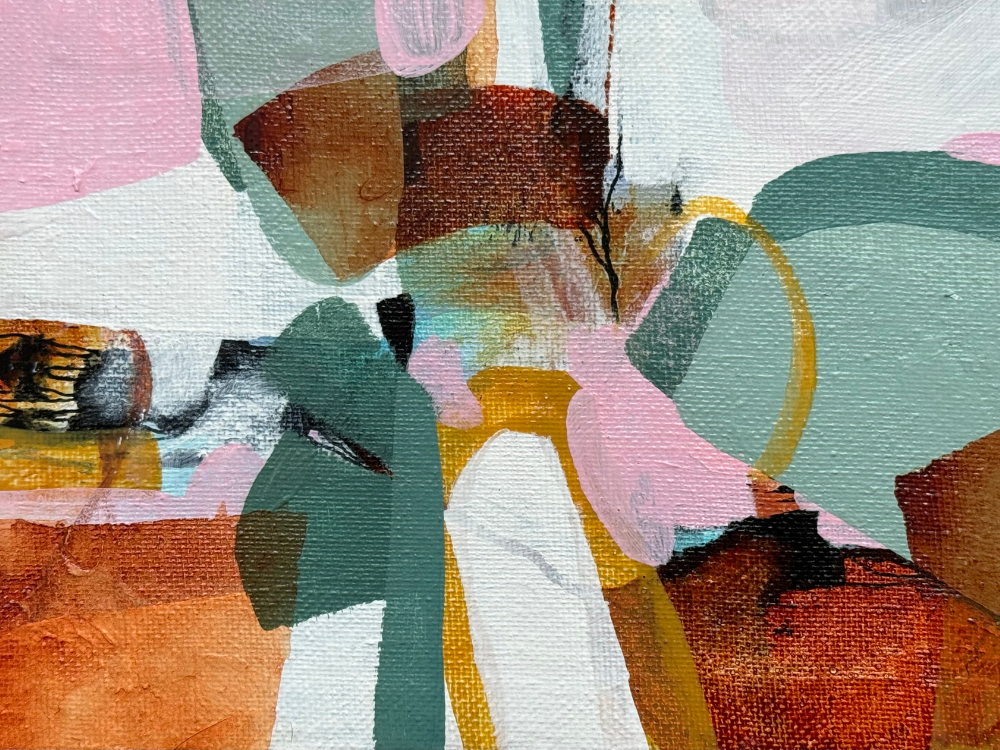
For two years spanning the pandemic, I worked for a design build firm that engineered tensile structures. Much of it was public and civic work, structures built for shared spaces. They held their shape entirely through tension, the same balance of pull and give I’ve spent years exploring in line. My interest in how built space holds people is part of why I serve as vice chair of the Oregon City Arts Commission and sit on the Travel Oregon City marketing board. It’s given me a closer view of how a community actually uses its arts and culture, and sharpened my interest in placemaking, in how civic spaces are designed to be experienced together.
Last year I trained as a therapeutic arts facilitator, learning to help people use art to reach what words may not. The same pull is behind my interest in neuroaesthetics, the study of what art actually does to the brain and the body. Both come back to the same thing: art doesn’t only get looked at, it changes how a person experiences themselves, one another, and the moment.
None of this adds up to a finished body of work. I’m still making it, still curious about what drives me to create. Even when nothing new is coming out of the studio, being an artist doesn’t stop. It just hasn’t shown up on the page yet.